Buying a sweater online can feel like a gamble.
The photos may look beautiful, the model may make the sweater look perfectly fitted, and the description may be full of words like premium, luxurious, soft, and high quality. But none of those things necessarily tell you whether the sweater is actually well designed.
As a designer, I look at knitwear a little differently. Before I decide whether a sweater is worth buying, I pay attention to the things that aren’t immediately obvious in the product photo: proportion, construction, silhouette, finishing, and how the garment is likely to behave on a real body.
The good news? You can do the same thing from your computer.
You don’t need to be a fashion professional or know how to knit. You simply need to know what to look for before you click “Add to Cart.”
1. Start With the Shape, Not the Color
Color is usually the first thing that catches our attention.
But when I’m evaluating a sweater online, I look at the silhouette first.
Ask yourself:
- Where does the shoulder seam sit?
- Is the body intentionally oversized or simply too large?
- Does the sweater taper toward the hem?
- How long is the body?
- How wide are the sleeves?
- Does the neckline look proportional to the rest of the garment?
A well-designed sweater usually has a deliberate relationship between these elements.
For example, an oversized sweater shouldn’t simply be a smaller sweater made much wider. The shoulder, sleeve, armhole, body width, and length should all be adjusted to create the intended silhouette.
This is one reason two sweaters made from similar materials can look completely different when worn.
Designer tip: Don’t ask only, “Do I like this sweater?” Ask, “Do I like the shape of this sweater?”
That’s a much more useful question.
2. Look Carefully at the Shoulder
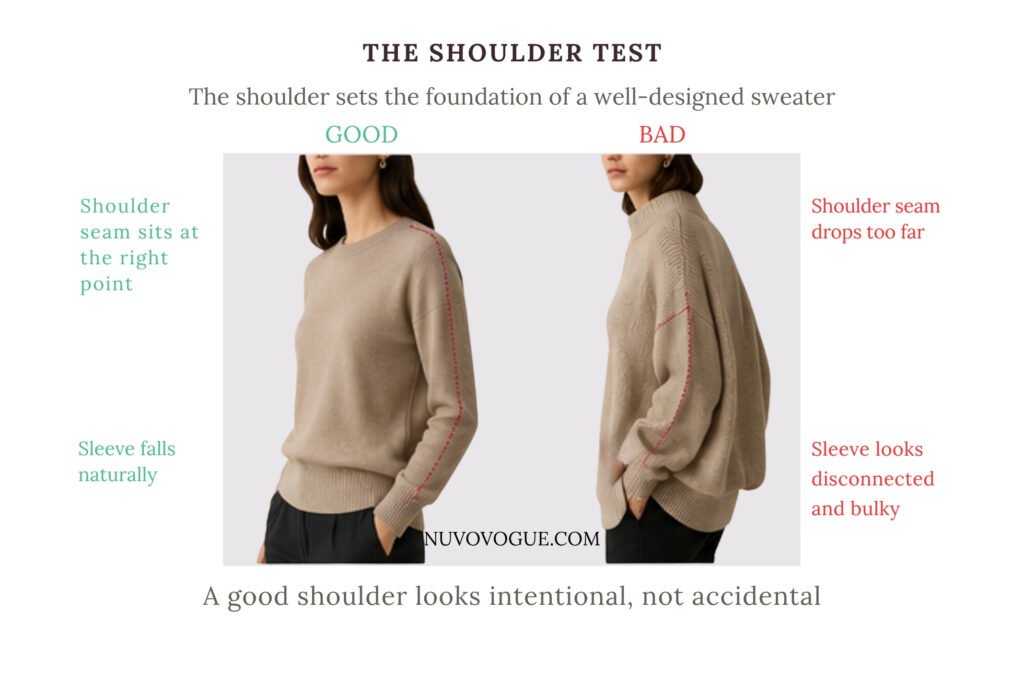
The shoulder is one of the easiest places to spot thoughtful construction.
Look closely at the model photographs. Can you see where the shoulder seam ends?
A traditional shoulder seam generally sits around the natural shoulder point. A dropped shoulder intentionally extends farther down the arm. Neither is automatically better.
The important thing is whether the construction looks intentional.
A dropped-shoulder sweater, for example, should usually have a silhouette that works with the extended shoulder line. If the shoulder is very wide but the sleeve is unusually narrow, the garment can look awkward rather than relaxed.
This is particularly important with oversized sweaters.
Oversized does not mean shapeless.
Good oversized design still has proportion.
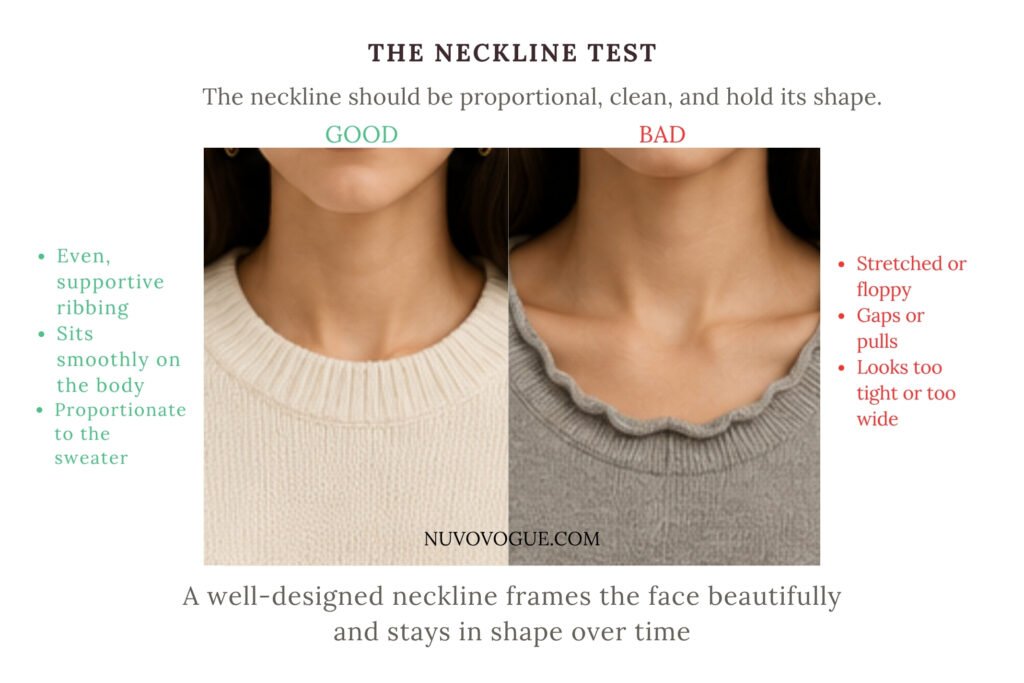
3. Zoom In on the Neckline
The neckline tells you more than you might expect.
On product pages, zoom in on the collar and look at how it connects to the body.
For a crewneck, check whether the collar appears:
- evenly knitted
- cleanly attached
- appropriately sized
- substantial enough to hold its shape
A ribbed neckline should generally look intentional rather than thin and floppy.
Also look at the relationship between the neckline and shoulder width. A very small neckline combined with an extremely oversized body creates a completely different visual effect than a wider, more relaxed opening.
Neither is necessarily wrong. It’s about whether the proportions make sense together.
4. Study the Cuffs and Hem
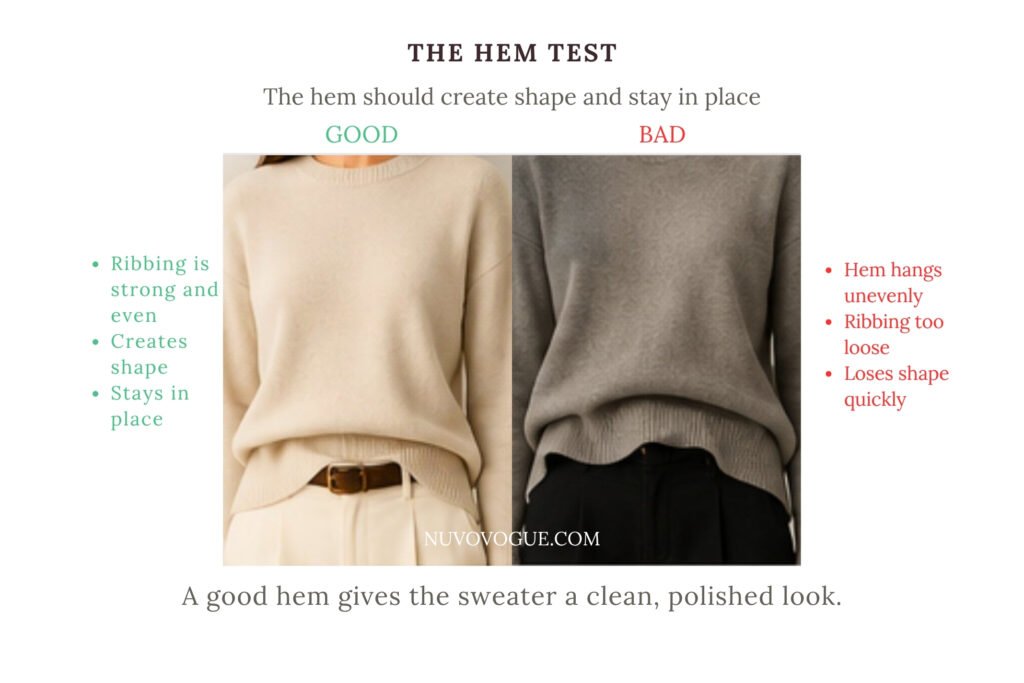
Here’s one of my favorite online-shopping tricks: look at the parts of the sweater that are easiest to overlook.
The cuffs and hem often reveal how much attention was paid to the garment’s construction.
Look for ribbing that appears:
- even
- consistent
- appropriately scaled
- securely finished
Pay attention to how the sleeve meets the cuff.
If the sweater is designed to have a relaxed, voluminous sleeve, the cuff may intentionally be narrower. That creates shape.
The same principle applies to the hem.
A sweater with a slightly structured hem can create a clean silhouette even when the body itself is loose.
This is why finishing details matter. They’re not merely decorative—they help control the garment’s shape.
5. Look at the Sleeve Proportion
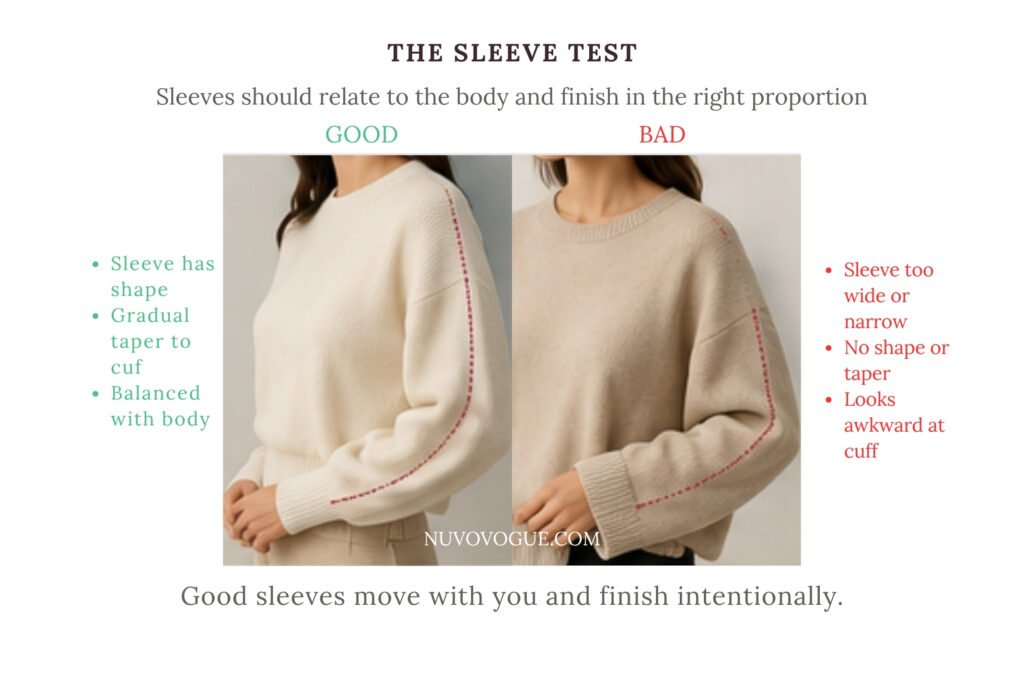
Sleeves are another place where poor proportions become obvious.
Look at the model and ask:
Where does the sleeve end?
Is it intentionally full-length, slightly cropped, bracelet-length, or designed to bunch at the wrist?
Then compare the sleeve width with the body.
A beautifully designed oversized sweater might have generous sleeves that gradually narrow toward the cuff. Another might have a straight, architectural sleeve.
What you want to avoid is a garment where the sleeve looks like an afterthought.
This is particularly important when shopping from photographs showing the model with her hands in pockets or posing with her arms bent. Those poses can hide the actual sleeve proportions.
If possible, find a photo with the model standing naturally.
6. Check the Seams
This is where your detective work really begins.
Look at the product photographs for close-up images of:
- shoulder seams
- side seams
- sleeve seams
- neckline
- cuffs
- hem
You don’t have to know every type of knit construction to learn something from these areas.
Ask whether the seams look clean and consistent.
If the sweater has a pattern—such as cables, stripes, or a textured knit—look at whether the design appears to continue logically across the garment.
Pattern alignment can be particularly revealing.
When stripes or other prominent motifs meet at seams, good construction generally considers how those elements interact. They don’t always have to match perfectly, especially in intentionally relaxed knitwear, but obvious awkward interruptions can tell you something about the garment’s construction.
7. Don’t Ignore the Back of the Sweater
Many online shoppers spend 95% of their time looking at the front.
I always want to see the back.
The back can reveal:
- shoulder proportion
- overall length
- how the garment hangs
- whether the hem curves or stays straight
- whether the sweater is intentionally oversized
- how much ease has been built into the design
If a retailer provides a back photograph, use it.
If they don’t, that’s useful information too. It doesn’t automatically mean the sweater is poorly made, but you have less information with which to evaluate the design.
For an expensive-looking wardrobe, information is part of the buying process.
8. Read the Fiber Content Before Reading “Luxury”
This is where marketing language can become distracting.
Words such as luxurious, premium, and cashmere-like are descriptions—not fiber content.
Find the actual composition.
You might see:
100% cotton
or
70% wool / 30% cashmere
or
50% viscose / 28% polyester / 22% nylon
Those compositions behave differently.
There is no single fiber percentage that automatically makes a sweater “good.” A blend can be intentionally engineered for softness, durability, shape retention, warmth, or cost.
The important thing is understanding what you’re buying.
A sweater designed for frequent wear may benefit from a blend rather than a delicate luxury fiber. Conversely, if you’re specifically looking for the hand feel and insulating properties of wool or cashmere, the fiber composition becomes much more important.
Don’t let the adjective make the decision. Let the specification do it.
9. Look at the Knit Density
This one requires a little practice.
Zoom into the fabric.
Does the knit look compact and stable, or very loose and open?
Again, neither is automatically better.
A chunky, open knit can be beautiful if that is the intended design. But you should understand that it may behave differently from a dense, fine-gauge knit.
A dense knit may create a cleaner, more polished appearance.
A looser knit can create softness, volume, and texture.
The question is:
Does the fabric structure support the design?
A delicate, loose knit paired with an extremely heavy oversized silhouette may behave differently from what you expect. It could stretch, drape, or lose its shape more easily.
The product photography can give you clues.
10. Pay Attention to Drape
One of the biggest differences between an ordinary sweater and a beautifully designed sweater is often how it falls.
Look at the model standing naturally.
Does the sweater:
- fall straight from the shoulder?
- gently follow the body?
- create intentional volume?
- bunch naturally at the wrist?
- hold a structured shape?
Try to imagine the sweater without the model’s styling.
This is important because styling can make almost any garment look more expensive.
A model wearing tailored trousers, beautiful shoes, minimal jewelry, and carefully styled hair can make a mediocre sweater look extraordinary.
Your job is to mentally remove the styling.
Look at the garment itself.
11. Read the Size Chart—But Think Like a Designer
Don’t rely exclusively on S, M, L, XL.
Sizing varies enormously between brands.
Instead, look at the actual garment measurements when they’re available.
Pay particular attention to:
- bust/chest width
- garment length
- shoulder width
- sleeve length
Then compare those measurements with a sweater you already own and love.
This is one of the most reliable ways to shop for knitwear online.
You aren’t asking, “Am I normally a medium?”
You’re asking:
“How does this garment’s geometry compare with something I already know works on me?”
That’s a much more precise approach.
12. Look at More Than One Product Photo
Never judge a sweater from the hero image alone.
Scroll through every photograph.
Look for:
Front view — overall silhouette
Back view — proportion and length
Side view — depth and drape
Close-up — knit texture and finishing
Model in motion — how the sweater actually behaves
Flat lay — construction and proportions without body styling
Every photograph gives you another piece of information.
If the retailer only provides heavily posed photographs, be cautious about drawing conclusions from the silhouette.
13. Use Reviews for Construction Clues
Customer reviews can be much more useful than the star rating.
Don’t just look for:
“Love it!”
Look for comments such as:
- “The sleeves are very long.”
- “The neckline stretched after washing.”
- “It runs wider than expected.”
- “The fabric is thinner than the photos suggest.”
- “The cuffs are tight.”
- “It keeps its shape.”
- “It pills easily.”
- “The sweater is heavier than I expected.”
These comments help you understand how the garment behaves in real life.
One particularly useful trick is to search reviews for specific problems, rather than simply reading the first few reviews.
If you’re considering an oversized sweater, look for mentions of the fit, length, sleeves, and shape retention.
If you’re considering a soft knit, look for comments about pilling and washing.
You’re essentially turning hundreds of customer reviews into a garment-testing report.
14. Don’t Confuse Minimalism With Good Design
A simple sweater can be incredibly sophisticated.
But simple doesn’t automatically mean well designed.
A plain crewneck sweater still requires decisions about:
- shoulder construction
- neckline proportion
- sleeve width
- body length
- hem treatment
- knit density
- finishing
- fiber composition
In fact, minimal garments can be harder to design well because there are fewer decorative elements to distract from proportion.
This is one reason a very simple sweater can look remarkably expensive on one person and completely ordinary on another.
The difference is often in the geometry.
15. My Five-Minute Online Sweater Test
Before buying a sweater online, I would run through this quick evaluation:
1. Silhouette: Does the overall shape look intentional?
2. Shoulder: Is the shoulder construction appropriate for the design?
3. Proportion: Do the neckline, body, sleeves, cuffs, and hem work together?
4. Fabric: Does the fiber content and knit structure make sense for the intended use?
5. Construction: Do the seams and finishing look clean?
6. Measurements: Have I compared the garment measurements with something I already own?
7. Reviews: Do customers mention stretching, pilling, awkward proportions, or shape retention?
If a sweater passes most of these checks, I feel much more comfortable buying it online.
And if it doesn’t?
I don’t care how beautiful the product photograph is.
I move on.
The Real Secret to Buying Better Sweaters Online
You don’t need to spend $500 on knitwear to find a sweater that looks sophisticated.
You do need to become better at evaluating design.
A sweater’s price doesn’t tell you everything about its construction. A recognizable brand doesn’t guarantee perfect proportions. And a beautiful photograph doesn’t necessarily mean the garment will look beautiful when it arrives at your door.
Instead, look at the garment like a designer would.
Study the silhouette.
Examine the proportions.
Zoom into the construction.
Read the fiber content.
Compare measurements.
And pay attention to how the sweater is designed to move and hold its shape.
Once you start looking at sweaters this way, online shopping becomes much less about guessing—and much more about knowing what you’re actually buying.