What kind of mother agrees to stand beside her adult son, turn toward him, and spit on him?
And what kind of son asks his mother to do it—not once, but repeatedly, every five years, over the course of decades?
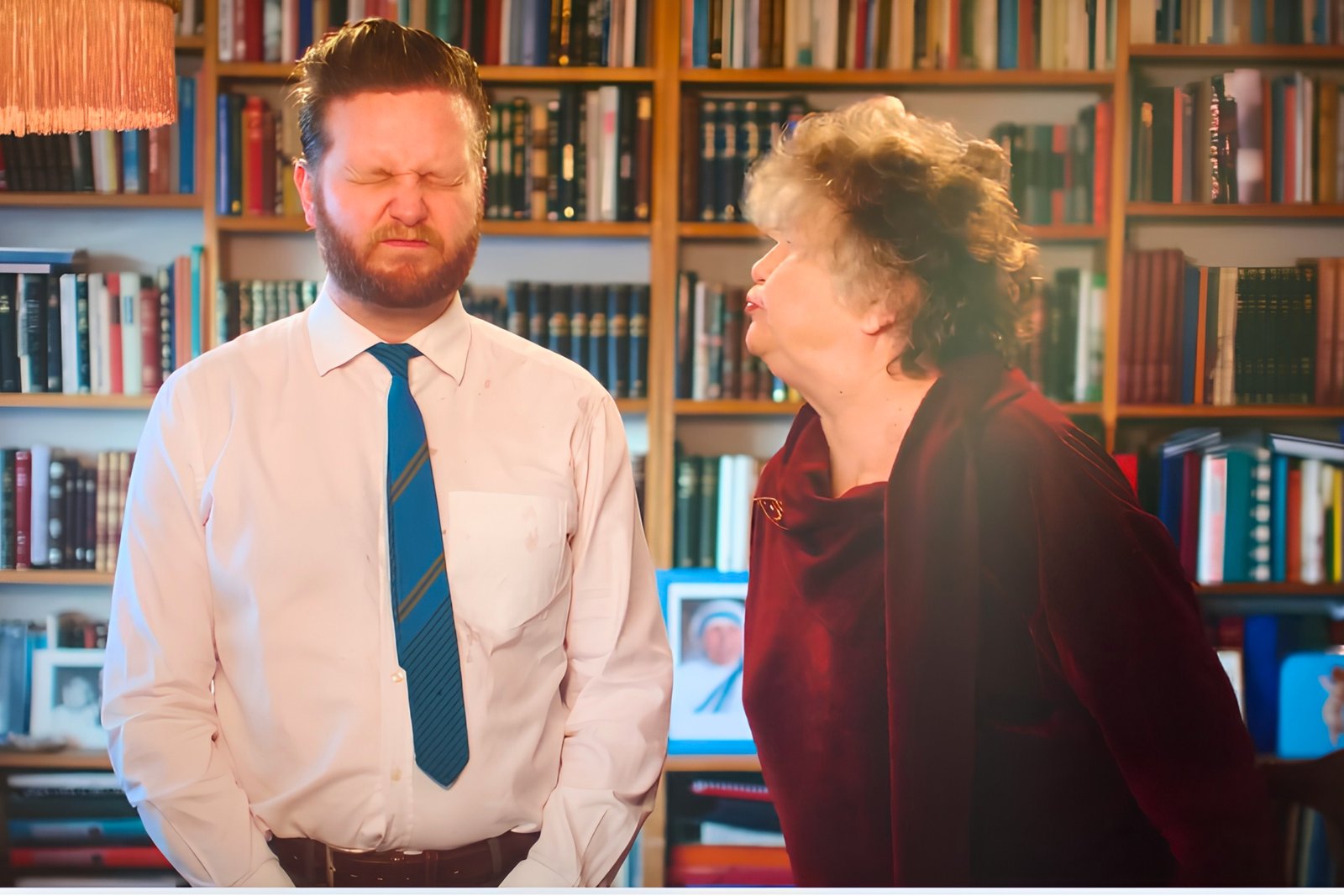
That is the strangely funny, uncomfortable, and surprisingly moving question at the center of Ragnar Kjartansson’s work The Death of the Artist, a performance-based series included in Politics of the Obvious, the artist’s ambitious new exhibition at AKG Art Museum.
At first glance, the scene sounds almost absurd. Kjartansson’s mother, Guðrún Ásmundsdóttir, a well-known Icelandic stage and film actor, stands next to her son. She turns toward him and spits.
There is no complicated storyline. No explanation. No dramatic confrontation.
Just the same strange gesture.
And then, five years later, they do it again.
The Most Un-Motherly Gesture Imaginable
Spitting on someone is hardly a universal symbol of affection. Spitting on your own child seems to violate almost everything we associate with motherhood: tenderness, protection, intimacy and unconditional love.
That is precisely what makes the work so powerful.
Kjartansson takes a gesture that feels instinctively wrong and turns it into a performance. His mother is not simply rejecting her son; she is performing rejection for the camera.
Her experience as an actor makes the distinction particularly revealing. Guðrún Ásmundsdóttir knows how to inhabit a role, repeat an action and separate a performed gesture from ordinary life. But this is still her son standing beside her. The theatrical act depends on a real relationship, creating an uneasy space between performance and sincerity.
That tension is central to Kjartansson’s practice. He grew up in theater and music, the child of actors, and repeatedly uses performance to expose the gap between what we see and what we feel.
Why Do It Again Five Years Later?
The answer may have less to do with the spit than with time.
Since 2000, Kjartansson has returned to the same action every five years. The gesture remains essentially unchanged, while everything around it does.
The two people age. Their faces and bodies change. Their lives change. The camera captures those changes without explaining them.
The five-year interval is long enough to make each repetition feel less like a routine and more like an encounter with time. If they performed the scene every day, it would become a joke or a ritual. Five years turns it into a record of aging.
The spit is the constant.
Everything else is temporary.
That is what makes the work unexpectedly emotional. What begins as a comic violation of the maternal role gradually becomes a portrait of a mother and son moving through time together.
When the Actor Becomes the Mother Again
There is also something particularly fitting about Kjartansson choosing his mother, an actor, for this project.
She can perform the act. She knows that the camera is watching, that the scene is constructed, and that the spit has been given a role within an artwork.
But the performance cannot erase who they are to one another.
The result is neither simply real nor simply theatrical. It is both.
That ambiguity allows Kjartansson to play with one of his recurring interests: how repetition can make an apparently obvious image strange. A mother spitting on her son should be easy to understand as an act of hostility. But when the same mother and son willingly return to the scene every five years, the meaning shifts.
The apparent rejection becomes a form of collaboration.
Part of Politics of the Obvious
The mother-and-son series fits naturally into Politics of the Obvious, an exhibition built around Kjartansson’s fascination with familiar images, clichés, cultural assumptions and repeated gestures.
Elsewhere in the exhibition, he takes other recognizable ideas and stretches them until they become strange.
In The Boat (2015), an elegantly dressed couple repeatedly crosses a beautiful, tranquil body of water before separating, evoking the idealized fantasy of luxury travel.
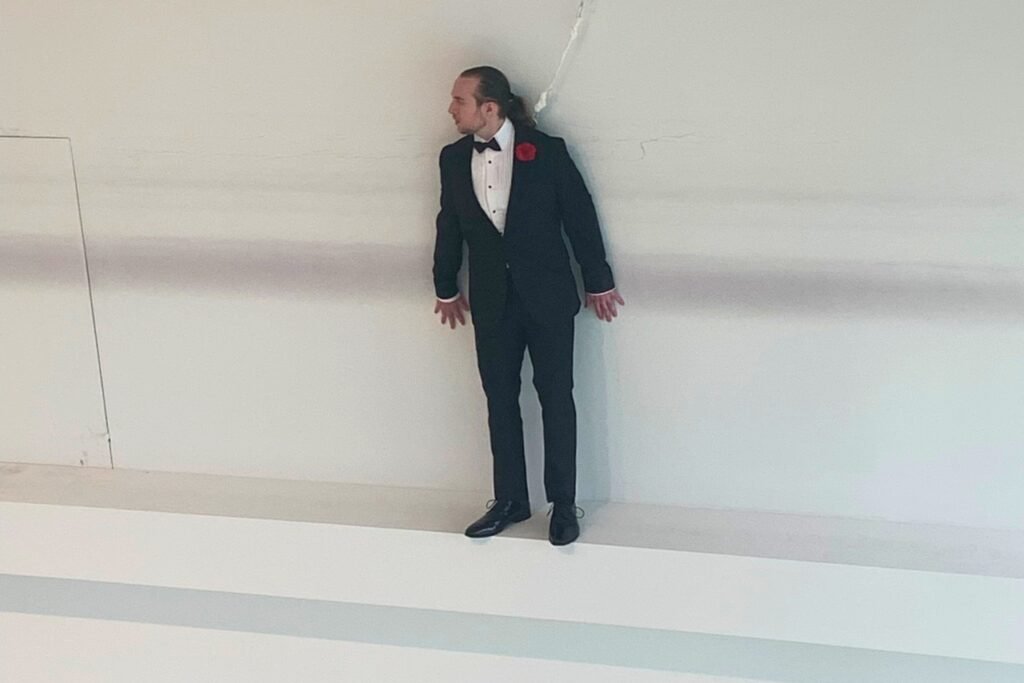
In Bangemand/Scaredman (2023), a man in a tuxedo nervously inches along a high ledge, turning the familiar image of masculine confidence into one of vulnerability and fear.
And in Sunday Without Love (2026), beautiful voices repeat the bleak statement, “You must learn to live without love,” creating an unsettling contrast between pastoral beauty and emotional despair.
Again and again, Kjartansson starts with something we think we understand.
Then he repeats it until we see it differently.