
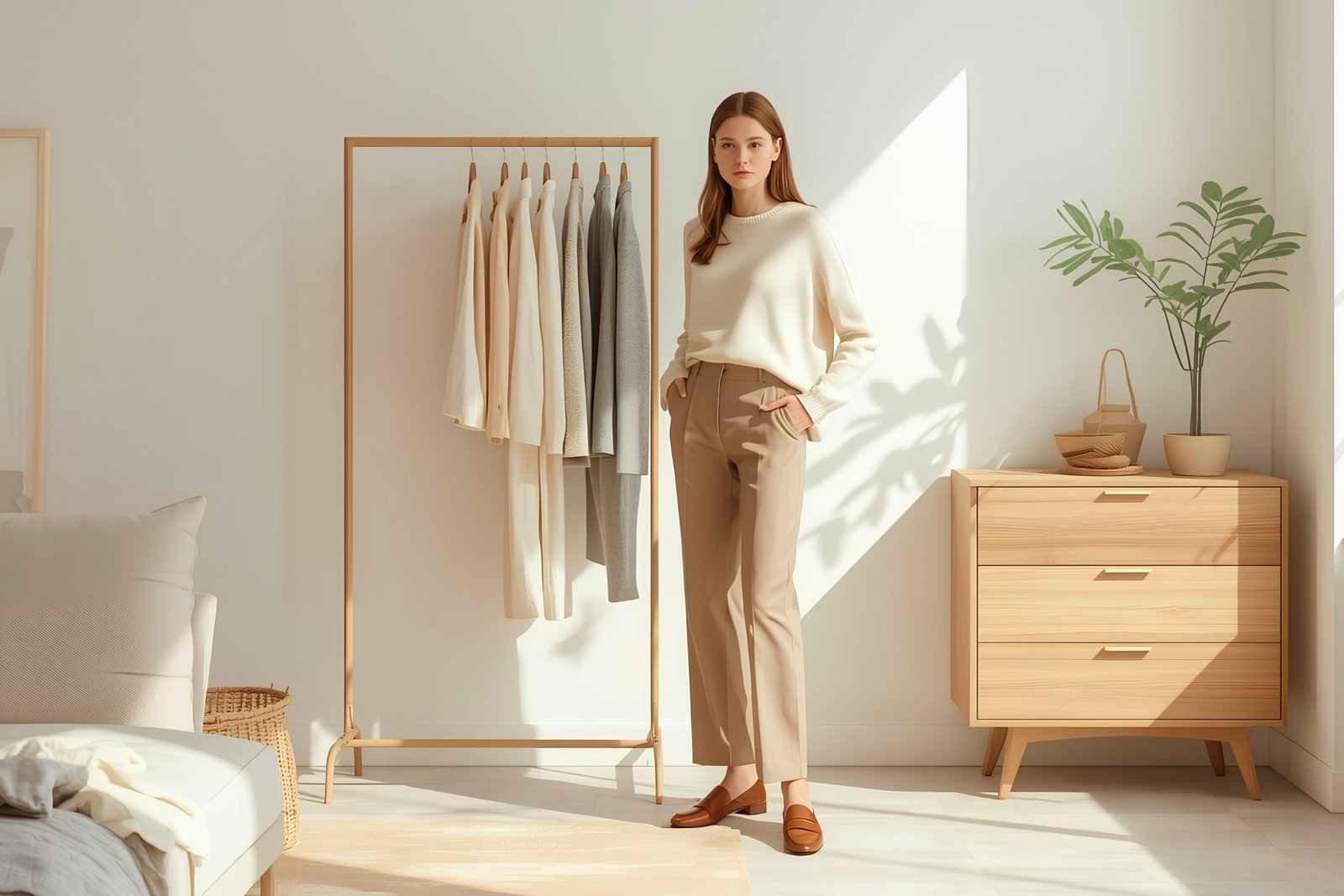
There’s a moment that most people who discover minimalism describe in almost exactly the same way. They look around at their home, or their wardrobe, or their schedule, and they feel it — a kind of low-grade exhaustion that they hadn’t quite been able to name before. Too much stuff. Too many choices. Too much noise competing for attention in every direction.
And then they start removing things. And something unexpected happens: the less there is, the better everything feels.
That’s the minimalist aesthetic in its most honest form. Not a design trend. Not an Instagram filter. A genuine response to the experience of having too much — and the discovery that less, chosen carefully, produces a life that feels more spacious, more intentional, and more genuinely satisfying than more ever did.
What Minimalism Actually Is
Minimalism gets misrepresented constantly. In its most clichéd form, it looks like a white room with a single chair and nothing on the walls — cold, sterile, and about as livable as an art installation. That’s not minimalism. That’s performance.
Real minimalism is simply the practice of keeping only what adds genuine value to your life and removing what doesn’t. It’s not about deprivation. It’s not about owning as few things as possible as a point of pride. It’s about being deliberate — about understanding the difference between what you actually need, what you genuinely love, and what you’ve simply accumulated out of habit, impulse, or social pressure.
The minimalist aesthetic, applied to how you live and dress, produces spaces and wardrobes that feel calm, considered, and quietly beautiful. Not because they’re empty, but because everything in them has earned its place.
The Minimalist Wardrobe
The wardrobe is where most people first encounter minimalism as a practical concept, and it’s a good place to start because the results are immediate and tangible.
A minimalist wardrobe isn’t small for its own sake. It’s small because it’s been edited — because everything that doesn’t fit, doesn’t flatter, doesn’t get worn, or doesn’t make you feel good has been removed, leaving only the pieces that genuinely work.
What remains tends to share certain characteristics.
A cohesive color palette. When everything in your wardrobe works with everything else, getting dressed stops being a daily puzzle and becomes something almost effortless. Most minimalist wardrobes are built around neutrals — black, white, cream, gray, camel, navy — with perhaps one or two accent colors woven through. The specific palette matters less than its cohesion.
Quality over quantity. A minimalist wardrobe with twenty pieces of genuinely good clothing functions better than a full wardrobe of mediocre ones. When you have fewer things, the quality of each thing matters more — which naturally pushes spending toward better materials, better construction, and better fit.
Timeless silhouettes. Minimalist dressing has no patience for trends. The pieces that earn a place in a minimalist wardrobe are the ones that look as relevant in five years as they do today — the well-cut blazer, the perfect white shirt, the beautifully draped trousers, the simple knit that goes with everything.
Fit as the non-negotiable. In a minimalist wardrobe, there’s nowhere for a bad fit to hide. Every piece needs to be right — which means tailoring the things that are close but not quite perfect, and being ruthless about removing the things that never quite work no matter how much you like them in theory.
Versatility as the primary criterion. Before anything enters a minimalist wardrobe, the question is always: how many ways can I wear this? A piece that works with three other things is more valuable than a piece that works with one, regardless of how beautiful it is in isolation. Versatility is the minimalist wardrobe’s greatest asset.
Building a Minimalist Wardrobe From Scratch
If your current wardrobe feels overwhelming rather than enabling, the path to a minimalist one begins with a single honest edit.
Take everything out. All of it, at once. This sounds dramatic but it’s the only way to see what you actually have rather than what you assume you have. Most people discover things they’d forgotten they owned, multiples of items they didn’t realize they had multiple of, and a significant number of things they genuinely cannot remember acquiring.
Keep only what you love and actually wear. Not what you paid a lot for. Not what you might wear someday. Not what someone gave you and you feel guilty about releasing. What you love and actually wear. Everything else goes.
Identify the gaps honestly. Once what remains is laid out, the real picture of your wardrobe becomes clear. You might discover you have twelve casual tops and nothing appropriate for work. Or four formal dresses and nothing that works for a weekend. The gaps tell you where to shop deliberately rather than impulsively.
Replace slowly and intentionally. Fill the gaps one piece at a time, choosing carefully and waiting until you find exactly the right thing rather than buying whatever is available. This patience is harder than it sounds and more rewarding than you’d expect.
The Minimalist Home
The same principles that produce a minimalist wardrobe produce a minimalist home — and the effect on daily life is, if anything, even more significant, because you live in your home in a way that’s more constant and more immersive than you wear your clothes.
A minimalist home doesn’t look empty. It looks considered. Every object has a reason to be there, and everything that doesn’t have a reason has been removed. The result is a space that feels calm in a way that’s genuinely different from other spaces — a calm that you feel physically when you walk in, a lowering of background mental noise that’s hard to articulate but unmistakable once you’ve experienced it.
Start with the surfaces. Clear surfaces are the fastest and most dramatic transformation available to any home, and they cost nothing. A kitchen counter with nothing on it but what’s used daily. A coffee table with one considered object rather than an accumulation of things. A bedside table with only what’s needed for sleep. These cleared surfaces change the feeling of a room almost instantly.
Edit furniture ruthlessly. Most homes have more furniture than they need — pieces that were acquired to fill space rather than to serve a purpose, or pieces that made sense in a previous home and have been carried along out of inertia. In a minimalist home, every piece of furniture is there because it’s genuinely needed or genuinely beautiful. Everything else is a candidate for removal.
Choose quality over decoration. A minimalist home achieves its beauty through the quality of what’s there rather than the quantity. A genuinely beautiful sofa in a beautiful fabric needs nothing around it to justify itself. A piece of art that’s truly loved needs nothing beside it to make it feel intentional. The investment goes into fewer, better things rather than more, cheaper ones.
Let architecture speak. Minimalist spaces tend to celebrate the architectural bones of a room — the quality of light through a window, the line of a wall, the texture of a floor — rather than covering them with decoration. This requires trusting the space itself, which most people find surprisingly difficult at first and deeply satisfying over time.
The Minimalist Color Palette
Color in minimalist spaces and wardrobes follows a specific logic: restraint and cohesion over variety and contrast.
The classic minimalist palette is neutral — white, cream, warm gray, soft beige, natural wood tones, occasional black. These colors share the quality of receding rather than advancing, creating a visual calm that allows the eye to rest rather than constantly finding new things to process.
But minimalism doesn’t require neutrals exclusively. Some minimalist aesthetics incorporate a single strong color — a deep navy, a warm terracotta, a forest green — used consistently enough that it becomes a signature rather than a statement. The key is always restraint: one considered color used deliberately rather than multiple colors competing for attention.
Warm neutrals versus cool neutrals produce very different feelings in a space. Warm whites, creams, and taupes feel inviting and human. Cool whites and grays feel sharp and contemporary. Neither is wrong — but knowing which direction your palette leans helps create the coherent, settled feeling that minimalist spaces aim for.
Texture becomes the primary design tool when color is restrained. In a neutral palette, the difference between a linen cushion and a velvet one, between a matte wall and a glossy one, between raw wood and polished stone — these textural contrasts provide the visual interest that color would otherwise supply. A minimalist space with a single color palette but multiple textures has richness and depth that a single-texture space lacks entirely.
Minimalism and Quality
There’s a direct and important relationship between minimalism and quality that’s worth understanding clearly, because it changes how you think about spending.
When you own fewer things, each thing bears more weight — more use, more scrutiny, more of your daily experience. A minimalist wardrobe with twenty pieces means each piece is worn far more frequently than one piece in a wardrobe of a hundred. A minimalist home with less furniture means each piece is seen and used constantly.
This makes quality not just desirable but essential. A cheap piece in a full wardrobe can hide. A cheap piece in a minimalist wardrobe is immediately visible and constantly encountered.
The minimalist approach to spending is therefore counterintuitive in a specific way: you spend less overall, but you spend more per item. You buy the genuinely good version of the thing you need rather than the adequate version, because the genuinely good version will last longer, look better, and produce daily pleasure rather than daily disappointment.
Over time, this approach tends to save money — not because minimalism is cheap, but because the things you buy don’t need to be replaced as frequently, and because the urge to buy new things diminishes significantly once your existing things are things you genuinely love.
The Minimalist Mindset
The aesthetic — the clean wardrobe, the considered home, the restrained palette — is the visible expression of something deeper. The minimalist mindset is a way of relating to the world that extends well beyond what you own.
Attention as a finite resource. Minimalism starts with the recognition that attention is limited and precious, and that every object in your environment makes a small claim on it. A cluttered space doesn’t just look messy — it actively fragments your attention in ways that affect your ability to think, rest, and feel calm. Clearing the space clears something in the mind as well.
Enough as a complete concept. Consumer culture is built on the premise that there’s always something more to want, something better to acquire, some version of your life that would be more satisfying if only you had the right things. Minimalism is a direct challenge to that premise. It asks: what if you already have enough? What if the satisfaction you’re looking for doesn’t come from more, but from a different relationship with what you already have?
Intentionality over impulse. The minimalist relationship with acquiring things is slow and deliberate rather than reactive and impulsive. Before anything new enters the home or the wardrobe, the question is always whether it genuinely adds value — not whether it’s appealing in the moment, not whether it’s a good deal, not whether someone else has one. Whether it adds genuine value to your specific life.
Contentment as a practice. Perhaps the deepest aspect of the minimalist mindset is the cultivation of contentment — the ability to find genuine satisfaction in what’s present rather than constantly orienting toward what’s missing. This is harder than clearing a wardrobe or painting walls white. It’s a practice, not a destination. But it’s also the thing that makes everything else feel worthwhile.
What Minimalism Isn’t
A few things worth clarifying, because minimalism gets misunderstood in ways that put people off before they’ve really tried it.
It isn’t about deprivation. Minimalism isn’t a punishment or an ascetic practice. It’s not about owning as little as possible or proving something through scarcity. It’s about owning what genuinely serves you — which for some people is thirty things and for others is three hundred.
It isn’t one aesthetic. The cold, white, Scandinavian minimalism that dominates design media is one version. But warm minimalism — natural materials, organic shapes, earthy neutrals — is equally valid. So is a more eclectic minimalism that keeps fewer things but allows for color and personality. The unifying thread is intentionality, not a specific visual style.
It isn’t permanent perfection. A minimalist home accumulates things over time — life happens, people give you things, needs change. The practice is in the ongoing editing, the regular return to the question of what’s earning its place. It’s a habit, not a one-time achievement.
It isn’t for everyone. Some people genuinely thrive in rich, layered, maximalist environments — surrounded by color and pattern and collections and objects that tell stories in every direction. There’s nothing wrong with that. Minimalism is a tool for people who find that less produces more ease. It’s not a moral position.
Where to Begin
The most common mistake people make when they decide to embrace minimalism is trying to do everything at once — clearing every room, editing every category, implementing every principle in a single weekend. This produces exhaustion and, usually, a rebound in the opposite direction.
Start with one drawer. One shelf. One category of clothing. Experience the feeling of that small cleared space — the visual calm, the ease of finding what you need, the quiet satisfaction of having made a considered decision rather than an impulsive one.
Then let that feeling guide you to the next thing.
Minimalism moves slowly when it moves well. It’s not a weekend project — it’s a gradual reorientation of your relationship with your possessions and your space that happens over months and years. The people who sustain it long-term aren’t the ones who did the most dramatic purge at the beginning. They’re the ones who developed the habit of asking, consistently and honestly, whether the things in their life are genuinely adding to it.
That question, asked regularly and answered honestly, is where minimalism actually lives. Everything else — the clean surfaces, the considered wardrobe, the restrained palette — is just what it looks like from the outside.
Minimalism isn’t about having less. It’s about making room for more of what actually matters.